It’s 1999: Let’s All Decorate With Giant Armoires To Hide Our TVs!

It’s another installment of Let’s All Decorate!, a series where we explore the design trends of the not-so-distant past! Today we look at what happened after the geese in bonnets and pastel southwestern decor was sent to Goodwill.

A wise man once said “when you’re living in America at the end of the millennium, you’re what you own.”

And when you were living in America at the end of the millennium, one of the things you owned was probably a bigass faux French-Country armoire that you hid your tv in.

We just all sit facing this closed up armoire GUYS IT’S TOTALLY NATURAL.

The question of how to make your television seem appealing is as old as TV itself. In the 50s, televisions were encased in these weird wooden tv boxes that were probably supposed to make them seem like furniture. My grandparents used one their whole lives. By the ‘70s, a lot of families had TV stands with shelves on the side and a big cut-out hole for the TV.

Raise your hand if you grew up with one of these guys; now raise your hand meekly if your parents still have it.

By the late 90s, we had moved beyond that. Television was no longer novel and impressive. All the fanciest people didn’t have giant televisions, they were bragging that they didn’t own one. What’s a TV junkie to do?

Sometime around 1997, some brilliant mind came up with a solution. Oversized, plush furniture was in vogue, and we all wanted to look like we lived in a cushy French country house. Except, with television. Because we’re Americans. So why not hide the TV in a giant tv sized armoire?

I’ll tell you why not. Because that was weird. First of all, most people’s TV armoires had the doors flung open all of the time anyway, because – will wonders never cease – people like to watch their televisions.

Second, why is your TV a secret? Are you actually embarrassed that people will enter your living room and know that you like to watch the NBC comedies on Thursday night? Do you even remember the late ‘90s? That TV block was amazing. I’d be ashamed NOT to watch it.

They even watched TV on TV.

And finally, is an armoire at all BETTER than a TV? If you’re going to be embarrassed about the state of your home, it’s probably worse to have guests think that you have so little clothing storage that you have to keep your armoire in the living room. Unless you are Belle (Poor Provincial Town Belle), and that thing is going to fling open its armoire arms and dress you in the finest French country fashions, it’s not a piece of furniture that needs to stay out in the open.

I can’t blame Americans for trying. At the time, I thought the TV armoire was a great look. Trading Spaces was about to hit the airwaves, and we were trying to channel our inner Grace Adlers. It replaced an unsightly television with a classy yet chunky piece of furniture. Then flat screen televisions came onto the scene, and as quickly as they appeared, the armoires were all sent back to… France? Maybe? Bedrooms? Closets? Where did they go?

Actually, a lot of people are finding fun ways to upcycle their TV armoires. And other people are still using them, which isn’t a terrible option if you don’t watch TV much or if it fits your living room. At this point they aren’t as ubiquitous as they used to be, so if you have a TV armoire today you aren’t following trends, you’re following your heart.

The point is, it took us decades, but eventually we realized that televisions are made to be watched, and hiding it in a weird piece of furniture doesn’t make it more attractive. No, what makes a television attractive is what is on it. Or who is on it. Whatever.

It’s 1995: Let’s All Decorate With Pastel Southwestern Stuff

Welcome to another edition of Let’s All Decorate!, where we explore the baffling interior design trends of days past! Today we look into a craze that swept the nation in the 1980s and 1990s, when pastels reigned supreme and appropriation was king. Long before we were all wearing “tribal print” shorts and flats, our parents were decorating in “Southwestern” style. Today, my friends, our walk down memory lane is lined with cacti.

It’s 1995. You’re a mom shopping out of the J.C. Penney catalogue, and you’re looking to revamp your home’s current look. All of those geese in bonnets and powder blue gingham are so 1890 1990. It’s 1995, Clinton is in office, TLC is on the radio, and “Navajo” motifs are all over page 178 of the fall Sears catalogue. You are modern, you are edgy, you are worldly, and now you own peach and seafoam lamps based on Native American vases. You are my mother. Hi, mom.

I think there were a few months when ducks in bonnets and “Southwestern” lamps lived in harmony in my childhood home. That’s before the Southwestern lamps killed themselves. One day one of my brothers knocked over one of the lamps. It was made of powdery terra cotta, and it shattered. The lamp was quickly replaced. Months later, we broke another one. My mom declared that the next person to break one of those lamps was going to pay for it themselves. Not a week later, she knocked one over dusting. Elizabeth Bishop had it right: “so many things seem filled with the intent to be lost that their loss is no disaster.” Those lamps were freaking ugly, and eventually, they lost the will to exist.

It wasn’t just my family: plenty of middle-class Americans – some from the Southwest, but just as many from the Northeast like us – wanted to paint our living rooms with all the Colors of the Wind. Possibly in Benjamin Moore’s Blue Corn Moon.

This living room from Ugly House Photos is peak Department Store Southwest. Note the pastel teal, the Native American porcelain doll, and what appears to be a Horn Of Plenty on the side table:

And how about this bedroom? America: where we will take your sacred land and build a strip mall on it, then fill the strip mall with a Pottery Barn that sells knockoffs of your art and furniture. I do really appreciate how they incorporated both a canopy bed and tiny rodent pelts.


Faux painting was a 90s decorating trend I’d rather forget. We all remember sponge painting and marbling, but this home, featuring faux primitive cave etchings, really takes the cake.

Is this a set from the smash tv hit Hey Dude? No, it’s a house with dehydrated cow skulls. If it looks like clip art scenery from Oregon Trail, maybe it doesn’t belong in your house. Or maybe it does.


I believe the following look combines the 90s penchant for Southwestern motifs with our brief love affair with Magic Eye paintings:


Falling under the category of “well, at least it’s less bad than the trail of tears, but then again so is just about everything:”


You don’t see Southwestern interior decorating much anymore, at least not outside of the bona fide Southwest or actual Native American homes. In those cases, it’s great! But I like to think that in white, northeastern homes, all of these teal and peach monstrosities made like my mom’s J.C. Penney lamps and offed themselves while they could.

It’s 1990: Let’s All Decorate With Geese In Bonnets

Welcome to Let’s All Decorate, an occasional series celebrating the wacky, tasteless, and all-out amazing home decorating fads of days gone by!


In the late ’80s and early ’90s, my mom loved ducks and geese. Actually, let me rephrase that. In the late ’80s and early ’90s, my mom hated ducks and geese. When a favorite walking trail was infiltrated with Canadian Geese and their human-sized poop, she was livid. We raised baby chickens every year – she was a fourth-grade science teacher – but when a colleague hatched ducks, she didn’t understand (“too dirty”). But like so many middle-class women, my mother loved pictures of ducks and geese, as well as ceramic statutes, cookie jars, and wallpaper borders. It is as though at some point around 1988, all of the moms of the world got together, probably over Snackwells cakes and an episode of Oprah, and decided hey, let’s all decorate with ducks in bonnets.

When I really think about it, the bonnets were the weird part. The “put a bird on it” trend is still going strong, so obviously people like surrounding themselves with the ephemera of avian life. Fine. But those birds are living wild and free, you know, like birds do. The ducks and geese of the late ’80s and early ’90s were adorned like women from yesteryear. I have so many questions about this. Did the birds put the bonnets on themselves – too much sun on the beak, perhaps? And how would a goose make a bonnet? Did a human dress them in clothes, and if so, why? And who was the first person who thought “hey, ducks are kind of cute, but you know what would be way cuter? If they dressed like a lady from the 1800s!”

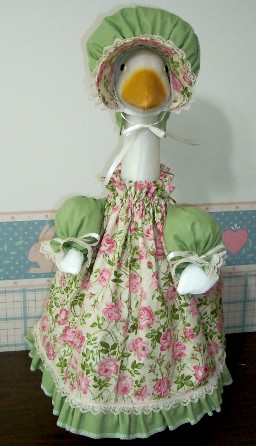
Look at this goose, dressed like she’s Laura Ingalls Wilder’s Duck Aunt:

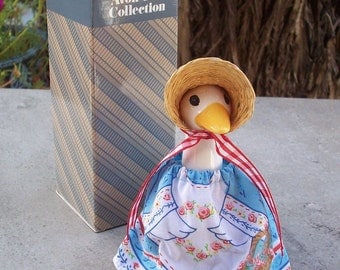
And this freaking bird, gussied up like she’s about to go a-courtin’ with Gilbert Blythe:

Or how about this bird, wearing an apron so she doesn’t muss her feathers while feeding the chickens or whatever:

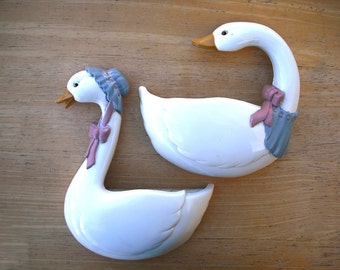
I’m almost positive my mom had these wall-geese:

This one goose has a shawl, because she’s chilly:And no kitchen was complete without this cross-stitched goose stuff, so all your goose friends would know that you welcomed them:

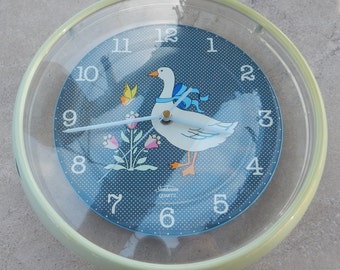
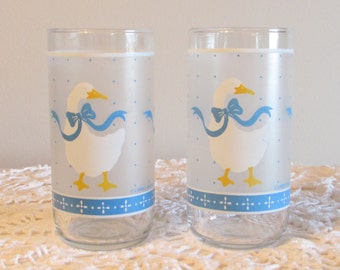
In 1990, it’s always Goose O’Clock (alternate slogan: “It’s Duck O’clock Somewhere?):It’s 1992. You’re thirsty. Best pour yourself an ice-cold glass of Goose Juice:

So, what social factors caused the Goose In A Bonnet fad? The trend has an almost perfect overlap with the Bush I presidency (1989 – 1993). Coming down from the go-go, Trump-and-taffeta Reagan era, were we all looking for something a little more homey, a little more rustic, a little more “waterfowl in sungear”? If so, it makes perfect sense that our interest in birds dressed like reenactors at a living history museum died just as the cynical mid-90s sprang to life; that when Gen X came into their own, they brought with them a sense of irony that had no room for geese that look like Hollie Hobbie.

Or was it the international tumult of the time –  Tiananman Square, the fall of the Berlin Wall, Iran-Contra, the Gulf War —  that had us all grappling for stability in the form of ducks outfitted like Strega Nona?
Friends, I think it was none of those things. I think it was pure, all-American bad taste. We talk a lot about all of the neon, day-glo nonsense that was going on 25 years ago, but let’s not forget about pastels. Bathrooms were outfitted with pastel peach and seafoam, with shadowboxes displaying shells and sand dollars. Living rooms had wallpaper borders with pictures of old-timey quilts. While most of the geese are in pale blue – a popular color during the pastel craze – you also see a bit of “dusty rose,” a dirty version of pink that people thought was a good idea.

I wonder if all of our chevron and naked birds and coral-and-teal is going to look as dumb as these Country Geese in 25 years (“Country Geese” is what they were called, and yes, it did take a long time on Google to learn this). I think the answer is maybe. But doesn’t it feel so refreshing to look back and remember a more innocent time, a time when we all said “hey, it’s 1990. The future is now. Let’s all decorate with geese in bonnets?”