Marilla Cuthbert Was A Creepy Church Hag : C+S Book Club

If you’re Canadian, imaginative, bookwormish, or red-headed, chances are at some point you read and loved Anne of Green Gables. Published in 1908, Lucy Maud Montgomery’s story is a timeless tale of orphans and family and imagination and screwing up your hair and dreams and getting your friend drunk by accident and Canada and Canadians and will they/won’t they romance and child-buying. Especially child-buying. When Anne, a plucky carrot-topped orphan with a heart of gold, ends up in Green Gables, she brings love, light, and happiness to Matthew and Marilla, a brother and sister who are married or whatever. Not to ruin this children’s classic for you, but Marilla wasn’t a kindly old lady trying to give an orphan a new start in life. She was a creepy church hag. Here’s why:

Marilla Tried To Buy A Little Boy To Do Chores

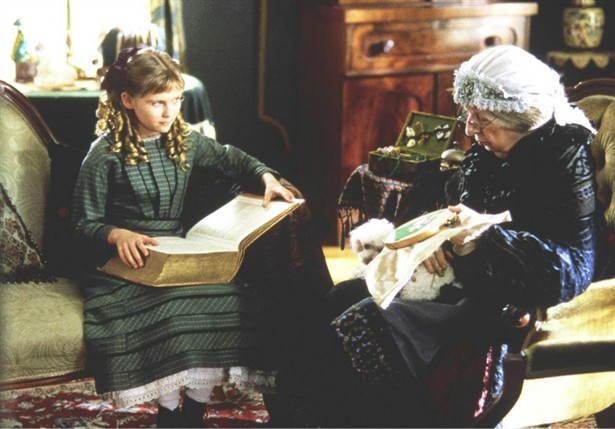
When her brother-husband got too old to run the farm, Marilla did the only logical thing (if you’re creepy and also awful) – she bought an orphan boy to do chores. Or tried to, because she got sent an orphan girl instead. Like Target, the orphan asylum has a pretty liberal return policy, but to her credit Marilla does keep the kid.

There Are Church Ladies, And Then There Are Church-Hags

… and Marilla is the latter. She initially kept Anne on a trial basis, like a mail-order vacuum. Even after she made up her mind, she wasn’t so sure about Anne –  because as a neglected orphan/indentured servant, I guess Anne’s bosses forgot to teach her about Jesus. Keep in mind, Anne was 11 and had already raised two families of what I can only picture as 19th century Garbage Pail Kids, so I guess she didn’t have time for scripture. Sorry Church-Hag, but she didn’t. To her credit (?), Marilla tried to buy a pre-Christianized orphan: she specifically told Rachel that she didn’t want a “London street Arab.” When Anne screwed up her bedtime prayers because nobody had ever cared about her enough to tuck her into bed and teach her social norms, Marilla said “Don’t you know it’s a terrible wicked thing not to say your prayers every night? I’m afraid you are a very bad little girl.”  But later,  when Anne tells Marilla about her boring day at church, “Marilla felt helplessly that all this should be sternly reproved, but she was hampered by the undeniable fact that some of the things Anne had said […] were what she herself had really thought deep down in her heart for years, but had never given expression to. It almost seemed to her that those secret, unuttered, critical thoughts had suddenly taken visible and accusing shape and form in the person of this outspoken morsel of neglected humanity.”

Yep. Marilla doesn’t even like church, but she’s still obsessed with it and tells small children that they’re “very bad” because nobody told them how to pray. And that, my friends, is a Church-Hag.

And Remember That Shit With The Brooch?

This is like 50% Marilla being a creepy church hag and 50% Anne being an idiot, so maybe you get the family you deserve. Anne gets all worked about about going to her first picnic and eating her first ice cream, and although picnics are uniformly less fun than you think they’d be (it’s seriously just eating, but outside), ice cream is awesome and she’s right to care so much. But Anne borrows Marilla’s brooch and leaves it on her shawl, and then Marilla thinks Anne stole it because orphans and heathens or something. So Marilla says Anne can’t go to the picnic unless she confesses to taking it. Anne gives a false confession under duress, and I can’t blame her because I would have confessed to murder when I was 11 if it meant I could get some Ben & Jerry’s. Still would. Then Marilla’s all “well, now you definitely can’t go to the picnic,” and Anne doesn’t know that picnics are lame yet so she is pissed. Then they find the brooch, and Marilla learns a valuable lesson that non-church hags never really need to learn in the first place: not to badger orphan children into confessing things they never did because you can’t keep proper inventory of your own stupid brooches.

She Uses Wine “Medicinally” … But We All Know What’s Up

Anne tries to give Diana raspberry cordial, but accidentally (or “accidentally”) rips into Marilla’s secret stash of currant wine instead. Marilla makes the following excuses and admissions:

  • “Well, this story will be a nice handle for those folks who are so down on me for making currant wine” – so, it’s known in the community that Marilla has a problem.
  • ” I haven’t made any for three years ever since I found out that the minister didn’t approve”- EVEN YOUR MINISTER, Marilla. Even your minister.
  • “I just kept that bottle for sickness.” – AKA withdrawal tremors
  • “[The currant wine] couldn’t have the least effect on anybody” – well, no, not if your tolerance is off the charts.


Bitch, If You Have Enough Money To Buy A Human Child, You Can Afford Puffed Freaking Sleeves

Damn, Church-Hag. I don’t know the going rate for a chore-orphan in the early 1900s, like how many toonies or whatever, but if you have that kind of money you can probably buy that kid the ugly dresses she wants. So you have to buy a few extra yards of fabric for the kid’s stupid sleeves? Most teenagers at some point will tell you that they “didn’t ask to be born” but seriously, Anne didn’t ask to be born, orphaned, leased out as a work-horse to human breeding farm Mrs. Hammond, so starved for human contact in an orphanage that she creates imaginary friends in the mirror like Tom Hanks on a deserted island with a soccer ball, bought by old married siblings by accident, and then given the worst dresses. Do you know what Marilla dressed Anne in before Matthew took pity on her and bought her those ass-ugly sleeves? Wincey. I Googled it. It’s basically burlap.

Like, did you spend so much buying your orphan that you have to dress her in bag material? That’s not just cruel, that is straight-up terrible budgeting. Get an accountant, Church-Hag. Maybe you could work out a budget to save up for a heart.

You Are The Company You Keep. Marilla’s Company Is Rachel Lynde.

You know those people who manage to insult everyone, but everyone makes excuses for them? That’s Rachel Lynde, Actual Worst Person In The World. So by association, Marilla is the Actual Worst Person In The World. Marilla may be your classic Creepy Church Hag, but Rachel is an even more insidious Church Hag – the normal-seeming gossipy kind who makes fun of orphans. Rachel doesn’t even like Marilla. She compares Marilla and Matthew’s living situation to getting used to being hanged – which, also, is Rachel some kind of idiot, because I’m 100% sure you don’t get used to that over time, you just get more and more dead. Rachel is the kind of mean old bag who meets a motherless child and says things like “She’s terrible skinny and homely. […]  Lawful heart, did any one ever see such freckles? And hair as red as carrots! ” That one got me in the gut, as a fellow skinny, freckly redheaded kid and also a human with feelings. But Marilla makes Anne apologize for calling Rachel out, because Marilla is a high-school girl who is friends with the queen bee because she’s too afraid not to be friends with her. Frankly if I want this kind of petty Canadian mean-girling I would just watch season one Paige and Ashley on Degrassi.

Oh. The other “company” Marilla “keeps” is the child she bought by accident, so that doesn’t really speak too well of her either, does it?

The Legacy Lives On

Despite her creepiness, Marilla has some good points. She does decide to keep Anne, and doesn’t do a totally awful job raising her, and Anne is so dense and weird that I can’t blame Marilla for getting frustrated sometimes. When Anne and Gilbert finally get their act together, they even name a kid after her (and honestly, that’s a whole other post — Anne And Gilbert: Shit Or Get Off The Pot, or alternately, Anne And Gilbert: When You Hate Someone It’s Probably Not Because You Secretly Love Them). Marilla was a creepy church hag, there’s no doubt about it, but she was at least a sort of crusty, lovable creepy church hag. In fact, if I ever buy a child to do chores for me, I hope I can be half of the owner-parent that Marilla was to Anne.


Life Lessons From The Fault in Our Stars: C+S Book Club

Hey C+S Book Club-ers! Last time we visited Harriet the Spy, and since we’re ladies in our *late 20s*, our next choice is obviously a little more mature than a kid spy. This time it’s about teenagers.

By now, most of you have heard about or read John Green’s The Fault in Our Stars, a young adult novel about two teens, Hazel Grace Lancaster and Augustus Waters who meet and fall in love. Oh and they both have cancer. I remember reading this for back when it first came out and appropriately crying harder than I have ever cried before. Legit had to stop reading it for a few days because it made me that sad. Now that the movie is coming out today, I can only imagine how that feeling will be magnified thousands of times more once I see it with my eyes. But essentially, TFiOS isn’t supposed to be a sad story, it’s supposed to be a celebration of life, no matter how long or short it is. So with that, here are just a few of the life lessons I gleaned from reading this book – **spoilers ahead** (but you should really read this book and see the movie anyways).

You can’t escape the hurdles

“I wondered if hurdlers ever thought, ‘This would go faster if we just got rid of the hurdles.'”

Hazel & Augustus initially meet in a cancer support group for teens, so a lot of the folks we encounter in the book (save for the parents and hospital staff) have been dealt a rather bad card of hands when it comes to overcoming difficulties in life. But it’s there in front of them, and the only thing to do is try to clear it and get to the next problem. We may face hardships in our life, but we can’t just give up. What would become of us if we didn’t have hardships or hurdles to get over and improve our lives (hopefully) for the better? The things that try to bring us down in the past only make us stronger. And then we can look back and see just what we’ve gone through.

Pain demands to be felt

“That’s the thing about pain – it demands to be felt”

Pain wouldn’t be pain if we didn’t at least feel something when we get hurt. You can’t go on avoiding something that you know is going to hurt you because you don’t want to feel it. If you do, it’s going to get worse and worse, so it’s better to just let it all out. In TFiOS, Augustus’ BFF Isaac has eye cancer, and subsequently has to undergo surgery which leaves him blind. During this time, his girlfriend breaks up with him, and he has so much rage that he just needs to let it all out. Augustus lets Isaac demolish his old basketball trophies in his basement, as if it’s no big deal. Why? Because Isaac needed to let it out. There’s no use of keeping that anger and frustration in. And while it might be gut-wrenching as it happens, that pain needs to be felt – or it will never go away.

Time isn’t good to anyone

“What a slut time is. She screws everybody.”

I can’t tell you how many times over the past few days I’ve said, “HOW IS IT JUNE ALREADY?!?” When we want time to speed up, it seems to slow down. When we want it to slow down, it’s like it’s gone in seconds. Luckily, everyone is a victim of time’s bitter kiss. Both Hazel and Augustus know they don’t have very good chances of staying alive forever, so it’s even more frustrating that they fall in love knowing this devastating fact. But the most they – and we – can do is make the most of our time, and not waste it on things we will regret doing.

Dare to be fearless

“Our fearlessness shall be our secret weapon.”

It’s easier said than done, but a problem I think a lot of people have is not being afraid to jump in and do something out of your comfort zone, no matter the outcome. We worry too much about what’s going to happen next that we don’t think about how great it could be if we even try. For the longest time, Hazel put her feelings about Augustus to the side, and refused to let their friendship turn romantic, as she called herself a “grenade”, ready to explode at any second. She finally put that fear aside and let her guard down, only to experience one of the greatest loves of her life.

Your true self is revealed in the darkest of times

“Grief does not change you, Hazel. It reveals you.”

Like 9/11 or the Boston Marathon, there were the people who ran away from the explosions, then there were the first responders who initial reaction was to run towards the problem to see who they could help. That first gut reaction of how you respond to something tragic and life-changing tells a lot about you as a person. You can either give up, not face the “hurdles”, or you can be strong, live a life – live a better life knowing that whatever caused you grief in the first place has since given you reason to become a better person. When Hazel and Augustus visit the Anne Frank House in Amsterdam, Hazel takes note that Anne’s father, Otto, was the only one out of their family to survive the Holocaust. She says, “I thought about Otto Frank not being a father anymore, left with a diary instead of a wife and two daughters.” Otto eventually decided to publish that diary, and of course it went on to become on of the most revered and studied books from the war. Otto didn’t give up when he was left alone – he preserved their legacy.

You can’t always get what you want

“The world is not a wish granting factory.”

“Cancer perks” are what Hazel and Augustus call the things they’ve received in sympathy for their struggles with cancer, you know the Make-a-Wish type things. Throughout the book, they make it clear that their sickness is not what defines them, it’s just something they have to live with, therefore the cancer perks, while usually cool, ultimately doesn’t give them what they really want. If you do want something, you have to work for it, and if you don’t get it – you don’t get it. Not everything is going to work out in your favor, but the most we can do is try.

A life is still important, no matter how long or how short

“Some infinities are bigger than other infinities.”

Probably one of the most quoted excerpts from the book, this line really sums up the entire story of Hazel and Augustus. Towards the end of the book (again, spoiler alert, I’ve warned you twice!) Augustus dies, another teenager succumbing to that bitch called cancer. While his life may have been short compared to you know, people who live to be 100, he still lived a significant life. The point of the book isn’t to feel sorry for Hazel and Gus, it’s to remind us that a life, no matter how long, or how short, can still make a profound impact on those around you, but it’s our choice  as to how we decide to live it.

Life Lessons From Harriet The Spy: C+S Book Club

Welcome back to C+S Book Club! Last time around we focused on that total bitch Amy March, and now we’re celebrating another childhood favorite — Harriet The Spy.

Louise Fitzhugh’s Harriet The Spy feels so current – controversial, even – that it’s hard to believe it turns 50 this year. Whether you were a nosy kid, an aspiring writer, or just fascinated by the world around you, Harriet The Spy spoke to a lot of us. Like all the best children’s books, Harriet The Spy was banned by adults couldn’t deal with how awesome it was, probably because it contained real talk contains real talk that adults don’t think 9-year-olds are ready for. In the case of Harriet The Spy, the lessons were lifelong.

Sometimes The Whole Truth Isn’t The Kindest Thing

This lesson is the hardest thing for Harriet – and it’s one that I’m still working on when I write. The sixth-grade jerks find some awful things about themselves when they read Harriet’s notebook (never have I been so indignant on a character’s behalf!). Harriet just wrote what she saw, but the unflinching honesty was a little unkind.

I discovered censorship in first grade. I was writing a story about two siblings fighting, and had the sister scream “I hate you!” at her brother during the argument. My teacher changed it to “I dislike you!”  I was furious – who, in a fit of childhood rage, has ever screamed “I dislike you!” at their sibling? I still believe that good writing requires honesty and authenticity. But when talking about real people, sometimes you have to soften your “I hate yous” into “I dislike yous” for the sake of real feelings.

Fitzhugh said it best: “Little lies that make people feel better are not bad, like thanking someone for a meal they made even if you hated it, or telling a sick person they look better when they don’t, or someone with a hideous new hat that it’s lovely. But to yourself you must tell the truth.” Observe honestly, think honestly – but smooth out the truth with little lies when you need to.

“There Is As Many Ways To Live As There Are People On The Earth”

One thing that huffy moms didn’t like about Harriet The Spy was the cast of wacky characters that Harriet spies on – people who resemble the weirdos and quirks that bona fide children run across all the time. There was the cat man, the family who owns the Chinese grocery, the grand Agatha K. Plummer.  Even your most mundane-looking families are all different from each other if you just watch them. Maybe it’s not so much these characters that set parents ill-at-ease, but rather Harriet’s assessment of them:

“Ole Golly says there is as many ways to live as there are people on the earth and I shouldn’t go round with blinders but should see every way I can. Then I’ll know what way I want to live and not just live like my family.”

See Everything. Write Everything.

We’ve all heard the advice to write what you know. It follows that the more you know about the more you can write about. If you want to be a writer, like Harriet, you have to keep your eyes and ears open so you can learn about all the ways there are to live. A book full of characters who live the way you do – because that’s all you know – just wouldn’t be very good.

Harriet didn’t just see everything, she wrote everything – on Ole Golly’s advice. Really, what a great thing to tell an 11-year-old (or an adult!) who wants to write. You may have a lot of faith in your memory, but it’s fallible. You have to write everything because you never know what details you might want to use someday. Besides, everyday practice – something we recommend for kids who want to master a sport or an instrument – is necessary for writing, too.

Know What You Like

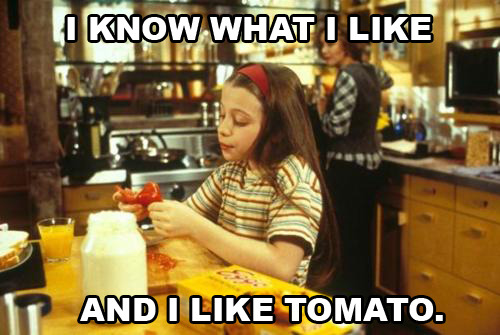
Harriet eats tomato sandwiches every day. She wears her same weird spy outfit every day, too. And how about the Boy With The Purple Socks? It’s not good to be bullheaded and resistant to change. But if you like tomato sandwiches, you don’t have to switch to egg salad just because people think you should.

Be A Harriet. Be a Janie. Be a Sport.

Harriet broke and entered into homes with a notebook in hand, pretending to be an 11-year-old Mata Hari. Janie set up a science lab in her bedroom, conducting weird experiments and learning everything she could about chemistry and physics. Sport lived with his dad and singlehandedly ran the household – including the finances – while dreaming of becoming a baseball player. Harriet, Janie and Sport all do things.

There’s nothing more annoying – even in adulthood – than people who expect you to be impressed by what they plan to do. You know, the people who talk ad nauseum about how they’ll open a restaurant or write a great book, but don’t take the boring, grueling baby steps to actually get there?  People who want to do things aren’t impressive, people who do them are – even if they try and fail.  I’m impressed by the people who take those awful boring writing assignments in the hopes that they’ll learn something they can apply later, or the people working the grueling lab job on a hunch that it will put them into contact with the best researchers. Harriet, Janie and Sport were just sixth-graders, but already they were the type of people who did things. They did things that might look weird to other people, simply because it’s what they wanted to do.

Do NOT Be A Marion Hawthorne. Do Not Be a Rachel Hennessy.

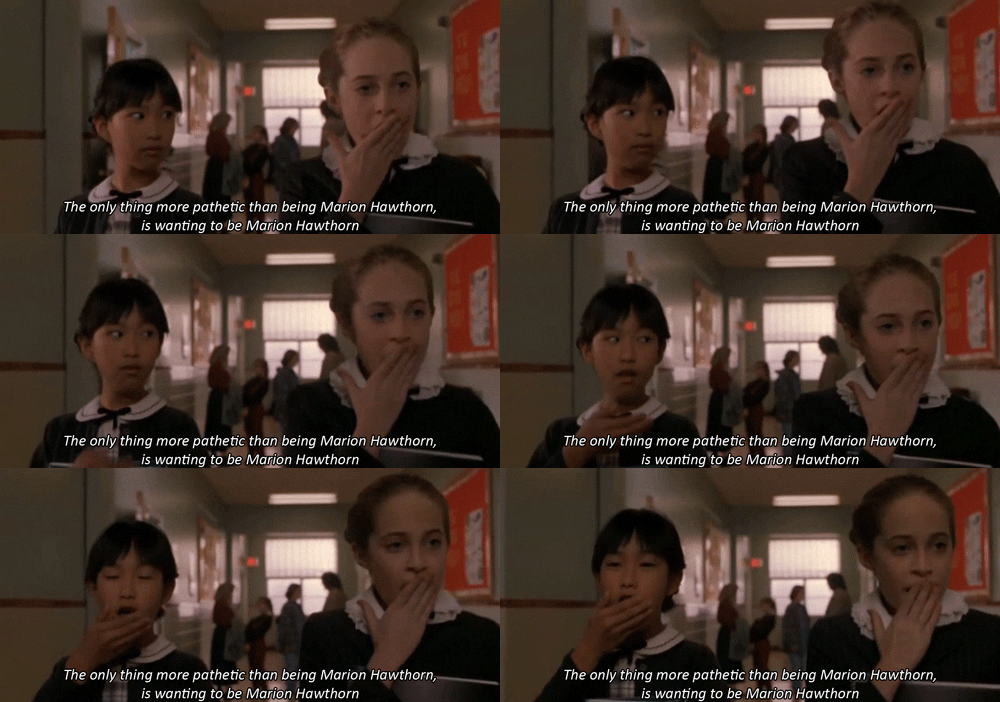
Harriet said “If Marion Hawthorne doesn’t watch out she’s going to grow up into a lady Hitler.” Harsh words, but Marion wanted the entire sixth-grade class to follow her blindly. One blind follower was Rachel Hennessy, who hosts the Spy Catcher Club (and who kids only like because her mom makes good cake). There was a whole pack of kids who followed Marion, and unlike Harriet, Jane, and Sport, they didn’t actually do things – other than try to bring Harriet down.

Change Is Hard

Ugh. Remember how painful it was when Ole Golly left? Even before that happened, Harriet was mighty jealous that her nanny was palling around with the bicycle man. Harriet reacted to these situations like a normal kid would – she pouted and threw a fit. When you grow up, you get a little better at covering it up, but this was one of the most honest parts of the book and a good lesson: change is really hard, and over time your new situation becomes normal to you.

The City Is Your Friend

Harriet The Spy is a distinctly New York City book, but it describes life that’s familiar to any city child. When you grow up in an urban neighborhood, all you have to do is walk out your front door to find all kinds of life to observe. The city itself – the sidewalks, corner stores, and most of all the people – is a character in Harriet’s life.

More broadly, Fitzhugh speaks to finding the fascinating things wherever you are. I thought my city childhood was compelling, and like Harriet I found that the most ordinary-seeming neighbors were extraordinary if I looked closer.  Wherever you live as a child or an adult – a big city or a small town or the suburbs in between – there are a million things to notice if you just open your eyes, close your mouth and grab a notebook.

You Might Screw Everything Up And Lose All Your Friends

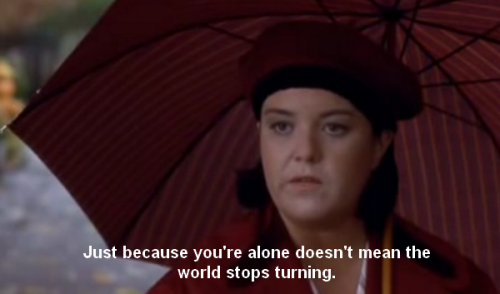
… and you’ll still be okay. This probably doesn’t happen so much when you get older (though it’s still possible), but remember those times in elementary school when you’d do one thing wrong, or have an argument with one friend, and all of a sudden it seemed like everyone was mad at you? When you get older, you can still screw up other things – there’s always something you can ruin, whether it’s a project at work or your tax return. If you give most things enough time, they’ll work out. In the meantime you have to fold up your pride, stick it in your back pocket, and try to make things right – and know that just because things went wrong doesn’t mean the world stops turning.


Man Crush Monday: LeVar Burton

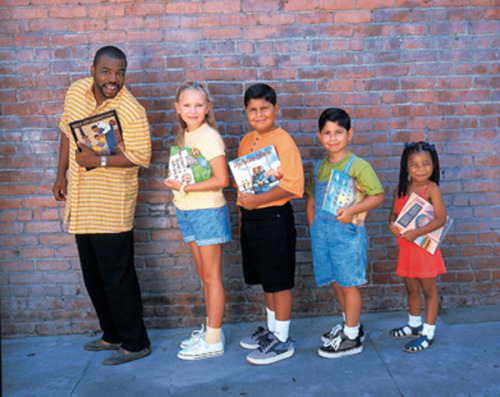
Today’s Monday man crush is a fellow you may not have thought about since you were reading books written and illustrated by Jan Brett*. I’m talking about the one and only LeVar Burton, the pot of gold at the end of the reading rainbow.

Before we get started, let me just tell you that if you’re looking for a post about liking LeVar Burton ironically, or any 90s nostalgic millennial nonsense like that, this isn’t the post you should be reading**. Levardis Robert Martyn Burton, Jr. is almost absurdly man-crushable – but you don’t have to take my word for it!***

Bringing Reading To Public Television

I know, I know. Public television is already the books of TV. But let’s go back to 1983, when Reading Rainbow started. Most people didn’t have 1000 channels***. They had, like 5 or so, and one of them was probably the local PBS affiliate. Most of the stations were showing 80s mom television during the day (meaning soap operas and talk shows by people who weren’t Oprah). PBS was basically it for kids programming, so this little show about books had a huge potential audience.

The producers of Sesame Street intended for their show to reach kids who weren’t necessarily getting pre-preschool learning prep at home. Reading Rainbow filled a similar role for older kids whose parents weren’t big into books, or maybe just didn’t have the time or language skills to promote reading.

Reading Rainbow had a lot going for it. The awesome celebrity guests – Eartha Kitt, anyone? – kept parents from changing the channel. The show format was almost genius in its simplicity, and the theme song was crazy-good – but the real draw was LeVar as a host. He was upbeat but didn’t use that stupid “talking to kids voice,” and he was enthusiastic about the theme of the episode, but never pedantic. Burton had the same quality as Mister Rogers (and, I’d argue, Amy Poehler in her Smart Girls series) – an adult who recognizes kids as full people.

Bringing Diversity To Public Television

Think about most of the men on children’s programs. So many white guys, right? Look, some of my best friends are white guys. But it’s really important for all kids out there to have a man on TV who actually looks like he could be their dad or uncle.

It’s not only that TV has an over-abundance of white people. People of color are also less likely to be represented positively.  Negative representation does a number on kids’ self-concepts. Remember that bummer of a social experiment where kids choose between white dolls and Black dolls, and all of the kids pick the white doll because they’ve internalized that the Black doll is “bad” and “stupid?” That’s what I’m talking about here. But for 30 years, kids at least had LeVar Burton on PBS – an affable, smart, cool relative- or neighbor-type.

White kids needed LeVar too, especially white kids growing up in predominantly white communities. Familiarity breeds … well, familiarity. That’s why my  inner-city childhood was so great – I didn’t grow up thinking of white people as the default humans. Watching LeVar Burton talk about Chris Van Allsburg books isn’t going to stop racism, but it at least helped white kids grow up thinking of one man of color as a nice, friendly guy who’s into books — and it might be some of the only exposure to that kind of representation that those kids have.

KUNTA KINTE, EVERYBODY

As two ladies who might like Event Television more than actual events, it’s a bummer that we missed out on the huge TV sensation that was Alex Haley’s Roots. But having seen it on cable later on, it really was a miniseries worth the hype.

Burton played the young Kunta Kinte, a young man who is kidnapped in Africa and sold into slavery in the United States. He was only 20 at the time, but Burton was such a pro — perfectly expressing the transition from a young warrior-in-training to a man struggling against the slave system by trying to escape and resisting a name change.

For my generation, LeVar Burton is the man from Reading Rainbow, but for people a little older than us, he’s Kunta Kinte. If you only know Burton from PBS, I suggest you find a copy of Roots and give it a watch.

Star Trek, If You’re Into That

We’re not into Star Trek. Like, at all. But we have it on good authority that people who are into Star Trek are real into Star Trek. So for those people, Burton’s tenure on the sci-fi show is probably one of their favorite things about him. Even if you’re not into space shows, you’ve got to admit that having a career portfolio that spans children’s television, science fiction and historical drama is pretty fantastic.

LeVar Burton Is Totally Cool With Himself

Some of the stuff LeVar did for Reading Rainbow was straight-up silly, which is awesome. He wore medieval regalia and got transformed into a troll, all for the sake of reading. What is more attractive a guy who is so comfortable with himself that he’d rather have fun than look cool? Burton even said “I fly my geek flag proudly.” Honestly, that’s the coolest ever.

Everyone Loves LeVar

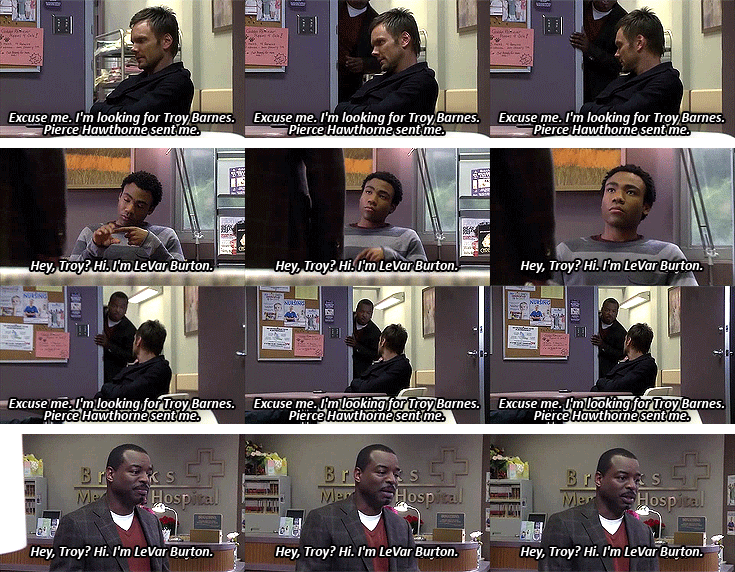
When was the last time you heard anyone talk smack about LeVar Burton? NEVER. And as children who grew up with Reading Rainbow become adults, Burton is in big demand. In the past few years alone he has made guest appearances in The Colbert Report, Community, and Wish I Was Here.

There’s An App For That

Do you really think that someone as awesome as LeVar Burton would get left behind the current wave of technology? Please. In the 80s, meeting kids where they were meant going to public television, but in the 2010s, kids are on the iPad. Seriously, if you ever have trouble doing something on your iPad, give it to the nearest three-year-old and they will be able to fix it for you. And then they will refuse to give it back for hours because toddlers LOVE tablets. The Reading Rainbow app promotes reading to kids who are less exposed than ever to tangible books – you know, the kind with pages and covers and stuff. You can read more about it here, but this app – like LeVar himself – is basically a huge deal.


* I get that Reading Rainbow repped all childrens’ books, but why did it always seem like it was Jan Brett’s Scandinavian kinder in knit woolens? Did my first-grade teacher just have one videocassette? Going forward, please realize that my memories of Reading Rainbow might be from one episode watched multiple times.

** DON’T LEAVE. You can still read our other posts. Here’s a Baby-Sitters Club musical libretto, and here’s a live-blog of Sharknado. AND THAT’S JUST TWO OF OUR THINGS.

*** Here’s where I ask you to take my word for it. Actually.

****  ⅔ of which are somehow the same channel listed multiple times. Be better, Time Warner.


Amy March Was A Total Bitch

Growing up in the 1990s, it was sort of normal for a girl to be into the 1800s. The American Girl catalog was in your mailbox, the Little House books were in your Scholastic orders, and everyone had a mom or grandma who was really into Dr. Quinn. The 1994 film adaptation of Little Women was right in the zeitgeist. When I saw that it was on tv around Christmas, nostalgia got the better of me. I had to watch. And, umm… something jumped out at me that didn’t when I was a kid. So, I decided to re-read the book on my bus rides to and from work, and it was confirmed.

Amy March was a huge freaking bitch.

I accepted early on that Amy was my March counterpart. While I loved writing and piano, I was neither a free-spirited tomboy like Jo nor a gentle, shy dead girl like Beth. And Meg — seriously, did anyone ever want to be Meg? Leave a comment if you did. No, I was an Amy. I’m also the youngest of four, and I – like many youngest children – am kind of hammy and want everyone to love me. Like the youngest March sister,  I’m even the only one of my siblings to miss out on getting a nickname. Alcott never mentioned it, but I just know that Amy felt like she got the shaft there.

So,while it does pain me to say this, let me repeat: Amy March was a total bitch. Let’s discuss:

Nobody Cares About Your Nose, Amy.

Amy hates her nose, which is described as a small, flat snub nose. Oh, so an adorable nose? A nose that is too cute? What a trial that must be – like those girls who complain about being “too pretty.”

Amy wants a “Roman Nose,” which according to Wikipedia, is “a human nose with a prominent bridge, giving it the appearance of being curved or slightly bent.” Wow, March. Have you ever got shit taste in noses. That’s probably what my nose looks like, and you know how I got it? Not by sleeping with a clothespin on it – no, I  broke it. Twice.

Oh, You’re Too Good for Hand-Me-Downs? Can it, Amy.amy-little-women-helen-page

The hardest thing in Beth’s life was dying of scarlet fever and the hardest thing in Jo’s life was having a dumb-bitch little sister who stole her manuscript, Eurotrip, and Laurie, but Amy — the hardest thing in her life was having a tiny, cute nose and having to wear hand-me-downs.

Alcott writes: “Amy was in a fair way to be spoiled, for everyone petted her, and her small vanities and selfishness were growing nicely. One thing, however, rather quenched the vanities. She had to wear her cousin’s clothes. Now Florence’s mama hadn’t a particle of taste, and Amy suffered deeply at having to wear a red instead of a blue bonnet, unbecoming gowns, and fussy aprons that did not fit. Everything was good, well made, and little worn, but Amy’s artistic eyes were much afflicted, especially this winter, when her school dress was a dull purple with yellow dots and no trimming.”

Look, I had a cousin who was an only child, and her mom shopped at the good stores. The day I’d get the big black trash bag of her hand-me-downs was like a freaking holiday. Oh, Florence’s mama sent you a red bonnet? Well my cousin’s mama sent me skorts and shortalls, and I was happy to have them.

Amy. Limes Are Stupid.

Poor thing. Always thwarted in her search for citrus fruits.

Pickled limes were the fashion at Amy’s school, because apparently she was educated with a bunch of other little dummies. So, Meg gave Amy the rag money to buy some limes, and I’m not even completely clear on what “rag money” is, but I’m pretty sure that if your family is poor enough to rely on something called rag money to supplement your income, safe to say you’re pretty hard up and shouldn’t be wasting your money on preserved citrus fruits.

Limes were outlawed in Amy’s classroom, but obviously all of the kids still brought them in, kind of like tamagochis in my school, circa 1998. [Sidenote: the spell-check suggestion for tamagochis is “masochists,” which is pretty apropos. What were we doing to ourselves? At least when limes are the 6th-grade trend, you don’t have to sneak off to feed it every 3 hours.] But, Amy wouldn’t give this girl Jenny a lime because Jenny was being a total bitch, so Dumb Bitch Jenny told the teacher that Amy had limes. He made Amy throw the limes into the snow and Amy had a fit even though a citrus fruit will do just fine in the snow. As a matter of fact, Amy couldn’t have known this, but in like 70 years they’ll invent this magical box that keeps food cold all of the time and – will wonders never cease – the food lasts longer. Also Amy’s limes are PICKLED, which admittedly is gross, but it means they can stay outside for a minute. [However, the limes do get stolen. We’ll go there later.]

Oh, and then the teacher hit Amy’s hand, which was majorly not cool. Our biggest bitches in this story are really the teacher and Dumb Bitch Jenny. Still, Amy’s a bit at fault for squandering the family’s rag money on some stupid limes.

Amy March Hates Irish People. This Irish Person Says Amy March Can Suck It.

The Republic of Ireland has retaliated by naming its least-appealing souvenir porcelain doll after Amy March.

When Amy’s limes got thrown into the snow, she wasn’t upset because she lost her limes – she was upset because the limes were “exulted over by the little Irish children, who were their sworn foes.” Yep, Amy March’s sworn foes were anonymous Irish street urchins. You bet your sweet bippy that one didn’t make the Winona Ryder movie. It wasn’t losing the limes that made Amy cry like – forgive me – a little bitch, it was the Irish kids getting the limes.

Amy. You live in Boston. Concord, whatever. You know those little Irish street children? They’re going to run your city. In 100 years, the descendants of one of those lime-eating Boston Street Micks is going to be our nation’s president. Your city’s basketball team is literally going to be called the Celtics. Don’t worry about what basketball is. If your grandchildren ever get arrested, you know who’s going to do it? An Irish cop. But you don’t even have to wait 100 years. Even in the 1860s, every one of those Irish kids has a pack of 14 siblings to back them up in a fight. And those kids are scary. They have been working in silk mills since they were 5. You know how my great-great-great grandmother survived the Potato Famine? By eating GRASS. Honestly, poor Irish children from Boston in the 1860s are probably the worst “sworn foes” you could make.

So, on behalf of Irish and part-Irish Americans, let me just tell Amy March that she can suck it. Know what she can’t suck, though? A lime – because the Irish kids got them. Booyah, March.

Ruining the ONE THING Your Sister Loves? Pretty Bitchy.

Remember when Amy was a little piss who burned her sister’s manuscript because Jo dared to have fun without her? God. What is your beef with Jo, Amy? Tell me. Because it’s sort of a recurring theme throughout the book.

On the plus side, I’d like to thank Amy March for the world’s first lesson that you should always, always back up your work.

You’re Using It Wrong, Ames.

I just cannot with this basic girl and her five-cent vocabulary. Honestly, though, Amy is 12 when the book starts, and that’s an 1860s 12. In 1860s Massachusetts, you could be a six-year veteran of the mills at 12. You could be betrothed at 12. But no, Marmee sent Amy to the ol’ schoolhouse instead, probably because of the child’s demonstrated inability to speak the English language. Look, Amy wasn’t spending her time watching tv or instagramming. The only thing to do was read books and learn how to use words properly, yet she was somehow incapable of doing it. For instance: “label” for “libel” (when she actually meant slander) and “vocabilary” for “vocabulary.” You just know this bitch says “liberry” and “pisgetti.”

I’m not saying I’m glad her teacher beat her at school, because I’m not, I’m just saying that if any of the March sisters deserved a formal education, it wasn’t Amy. All I know is, if Amy March lived today, she’d be that little cousin of yours whose tweets and Facebook posts are so incomprehensible that you basically have to do an English-to-English translation every time you read them.

She’s not even that good at art so maybe she should just shut up about it.

Amy March isn’t a real person, but she was somewhat based on Louisa May Alcott’s sister Abigail May. May probably had a lot of gifts and talents, but art wasn’t one of them. Here are some of her drawings:

Compare the scale of Marmee(?) in the chair with the girl to the right. It’s like a Cabbage Patch doll next to a Barbie.

My favorite part is the floating table.

May died young, and that’s sad, but you know what else is sad? These sketches.

I Ain’t Sayin’ She’s A Gold Digger (Yes, I am. Yes, she is.)

So, first Amy gold-digs her way into Fred Vaughn’s heart. Then, she sees the opportunity to get with Laurie, who in addition to being wealthy, also provides her with the opportunity to ruin Jo’s life. So, she does that instead. Either way, she’s a gold-digger.

Steals Jo’s Trip

Eyes on the prize, Li’l Amy. Eyes on the prize.

Jo put up with Aunt March’s Crappy Plumfield Storytime every day, with the understanding that at some point she’d get a Eurotrip out of the deal. Look, for a 20-year-old girl in the 1800s, it wasn’t as easy as just finding a college with a good study abroad program.

Then, Amy – freaking Amy – swoops in, befriends Aunt March, and gets the trip. As an indirect result, Jo had to move to a boarding house and marry an old German man.

Steals Jo’s Man

Jo and Laurie were endgame. I refuse to hear differently. Sure, Jo shot down Laurie’s proposal, but I think it was just the wrong time — she was coming back for him later, and that’s all there is to it.

So, when Laurie proposed to Amy — because she was the next-closest thing to Jo — Amy should have had the decency to know that Laurie was Jo’s one true love.

Instead, Amy was a total bitch, so she married him.

Conclusion

After all that, here’s the truth: now that I’m an adult, Amy is my favorite. Beth does nothing, gets scarlet fever, then dies. [Also, please don’t stone me, but did anyone else think Beth wasn’t exactly playing with a full deck?] Meg does nothing, twists her ankle, then gets married. Jo ruins her chance at true love, and acts so obtuse about how to behave in human society that I think she’s just doing it to get on her sisters’ nerves. She’s like that one girl in college who tried to be unconventional just for the sake of it, and you were always like “you know what? You’re not Amelie. Stop trying to be Amelie.”

Whether or not you think Amy is a huge freaking bitch (and don’t get me wrong, she is), that girl knew how to go after what she wanted. Somehow, she was ridiculously well-liked, but at the same time, you sure as hell didn’t walk all over Amy March. But, if I ever ended up with an Amy March of my own, I would need to make like Marmee and send her to live with a great-aunt for her teenage years – because honestly, what a little bitch.

Anne Of Green Gables 2013

Let’s talk about Canadian television. I lived in a border city for 3 years, and spent some quality time with Canadian TV. It’s mostly made up of American shows, hockey, people talking about hockey, Tim Hortons commercials, snow – just, like, programming about snow, because Canada has so damn much of it, and people who generally look all healthy and financially secure and smug because they all have health care. Every once in a while, you get a Degrassi in there. The piece de resistance of Canadian television is the 1985 CBC adaptation of Anne of Green Gables.

As a dramatic, bookish redheaded child, I was more or less obligated to love Anne of Green Gables. If you loved her, too, you will remember a few things about her. She was an orphan who always had her head in the clouds, she was outspoken but always meant well, and — oh yeah, she lived in the 18-fucking-hundreds or something. So when I heard that Canadian TV was adapting Anne of Green Gables to a modern setting, I was a little confused. None of the plotlines even make sense in 2013. Clearly, a couple tweaks are in order. Frankly, I don’t think Tim Hortons will even sponsor this mess.

Here’s what will happen if Canada brings Anne Shirley to the new millennium:

Matthew and Marilla are the worst people ever

The entire premise of Anne of Green Gables falls apart when you move it to this millennium. In the 1908 novel by Lucy Maud Montgomery, Matthew and Marilla order a boy from the orphanage in order to help Matthew with the farm work. They end up with Anne instead. In 2013, buying children to do manual labor is pretty illegal. An 11-year-old girl going to stay with elderly siblings who live together – because they buy her to do work – wouldn’t test well with today’s audiences. I think the only thing they could do is have Anne come from some sort of foster care situation, which would work with the prejudice ol’ Rachel Lynde has against her. Still, though, the show wouldn’t work if Marilla’s this warm, fuzzy older lady who just wants to help an underprivileged girl succeed. She sort of has to be a brittle church-hag who tried to buy a little boy for chores.

Bath Salts Are The New Raspberry Cordial

Remember when Anne invited Diana over for tea, then accidentally got Diana drunk on raspberry cordial, then they weren’t allowed to be friends for a while? Most parents still wouldn’t like the kid who got their daughter drunk, but I think raspberry cordial has lost some shock value in the intervening hundred years. It even sounds like an old-timey refreshment you’d have at tea-time. Nowadays, to get the same punch Anne would have to come across bath salts, sprinkle it on some food, then be all surprised when Diana goes on a drug-induced face-eating rampage. Or, Diana would have an allergy attack and Anne would mix up Zyrtec with Xanax and get Diana all spacey. You got to admit, for such a smart girl Anne could be a little dense sometimes.

“Carrots” Isn’t Really An Insult Anymore

You’ll remember that Anne and Gilbert’s hate-to-tolerance-to-friendship-to-love trajectory began with Gilbert mockingly referring to Anne as “carrots.” In 2013, any teen girl would be like “that’s all you got, Gil?”. In the modern adaptation, instead of calling Anne carrots, Gilbert’s going to set up a Facebook page called “Anne Shirley is a Fire Crotch,” and it’s going to get 300 likes in the first day. Anne won’t smash a slate over his head, she’ll create an unflattering gif set of Gilbert and post it to her tumblr. Josie Pye likes Gil’s page, obviously, because in 2013 as in 1890, Josie Pye is a freaking bitch.

Prissy Andrews and Mr. Phillips? Hello, Sweeps Month Drama

100 years ago, the weird moon-eyes Prissy used to make over Mr. Phillips was supposed to mean that she was a horrible suck-up who would probably marry him after she graduated at 16 or whatever. In 2013, it still means that Prissy is a horrible suck-up who will probably marry Mr. Phillips when she drops out at 16 or whatever (or 18 – not sure of the law there). However, it also means that Mr. Phillips is a total pedophile, which explains why he was so damn creepy. For a 3-episode arc, Anne of Green Gables will become a legal drama as they sort this whole mess out.

Green Hair Dye: Unlikely

Hardly anyone’s given me shit about having red hair, and the dozen-ish times that it has happened it didn’t bother me. So, I don’t think that a 2013 Anne Shirley would be so distraught over her auburn locks that she’d buy hair dye from a peddler and turn it green. I’m thinking she’d be more likely to lose her hair in a knockoff keratin treatment attempt. If the producers want to have a Very Special Episode, maybe Anne could get hooked on bootleg diet drugs or get a suspicious mole excised because she’d been tanning away her redhead complexion. After 100 years, teen girls are still trying wacky things to look better, but I think that carroty hair would be the least of Anne’s concerns.

Puffed sleeves are SO 1908

Anne waited years to be old enough to wear puffed sleeves. Like many young readers, I wondered what exactly that meant but imagined it to be the most beautiful sleeve configuration possible. Then, I saw the movie, and was horrified by these sleeves that looked like they were stuffed with wadded-up shopping bags and cribbed from a 1980s bridesmaid dress. I don’t know what the modern answer to puffed sleeves would be — something that’s considered too grown-up for a young girl, and which looks absolutely ridiculous. Is it half-shirts, now that those are back?

Anne Shirley is now 45 years old

As far as I’m concerned, Megan Follows is the only Anne Shirley. Since nothing about a modern-day Anne of Green Gables makes sense, I don’t see why we need to be all accurate and have a 13-year-old in the role. Let’s just stick with Follows. There may as well be something good in this whole debacle.

Matthew doesn’t die

If we can move Anne of Green Gables to 2013, we can do anything with the story, right? So, let’s let Matthew live and spare all of the little illiterate kids that psychic trauma. Children who have read the book can just keep that development to themselves.

Women’s Fashion (According To A 1976 Encyclopedia)

Remember how, before the internet, we had to read real, physical books to find things out? In my family, that meant turning to the cobalt-blue 1976 Encyclopedia Americana. One volume in the set was a yearbook that detailed the world events and current trends of the age. I was so obsessed with the fashion section — both out of genuine interest and childish snark — that the book still opens right to that page.

In the mid-90s, I turned to the Encyclopedia for help with Social Studies reports. In the mid-70s, people were turning to the Encyclopedia for help with looking as fly as possible. Such was the pre-internet age.

Let’s take a walk through 1976 fashion, as described in the vibrant pose of the Encyclopedia Americana editors.

  • “Chinese fashion”

    Shhh! Nobody can tell I’m Caucasian!

* Women’s fashion was “influenced by denim and China.” I hope that means you could buy a mandarin-collared denim dress or one of those flat rice-picking hat in Levi’s blue.

* The photo of the woman displaying “The Chinese look” looks like she’s wearing a kind of racist Halloween costume. I guess at least they didn’t say “Oriental?”

* Sometimes when I read this entry, I feel like a time-traveler from the future and wish that I could just save everyone without accidentally killing my own grandfather. The editors write that “politically, the effects of detente with China may not be known for years.” Not to spoil it, but the effects are a little known now and HOLY SHIT WE ALL NEED TO LEARN MANDARIN. What are you DOING, 1976? Stop importing their beautiful silk daywear because they are going to RUN us.

* Bitches wore mad “frog closings” and “coolie” jackets, I guess.

* OK, the encyclopedia DID end up saying Oriental, and they only capitalize it like half of the time. Casual racism is one thing, but casual racism AND sloppy copy-editing? I can’t.

  • Denim

* Real sentence: “The jean craze continued to mushroom at an unbelievable pace.”

* Another real sentence: “The better the figure was, the tighter the jean.” Hey 1976, could you please give that advice to literally everyone I saw at the bus stop the other day? Because the 2013 rule of thumb is apparently: “no matter what the hell your figure looks like, just say “screw it” and buys your pants 2 sizes too small.”

* In the “most horrible thing I’ve ever heard of in my life other than disease, hunger, and genocide” category: the “two-zipper” was in fashion. Jeans closed with two side front zippers instead of the usual fly front. I don’t even understand how this would work. Maybe one of you has an engineering degree and can help? I’m picturing a weird flap that would hang down, like an overall bib except in your crotch neighborhood, with a zipper on either side. If there’s one thing I definitely don’t need, it’s a 100% increase in the likelihood that I’ll forget to zipper my pants. I imagine that if you have any kind of stomach or side fat, it will accidentally get zippered into the “side front zippers” at least once.

* Unsurprising: “work” clothes like khaki fatigues, railroad overalls, and mechanic suits took off.

* Surprising: This “was an expression of the belief in the virtues of honest labor, even if the person wearing them was not engaged in it.” Encylcopedia Americana? You’re reaching. Although, sometimes I do wear a full McDonald’s uniform or nurses’ scrubs just to demonstrate that I believe in work. Who am I to talk?

  • Ladylike Dressing

* According to this section, sometimes women wore skirts and dresses, but other times they wore pants. That’s really the gist.

* Sometimes women wore suits, with “dramatic capes and soft coats” over “multilayers of separates.” The encyclopedia isn’t scratch-n-sniff, but I’m pretty confident they also smelled like sweat and patchouli.

  • The Sporting Life

* The jumper was back. A million home-schooling moms rejoiced, probably.

* Sweaters were “an education in ethnic artistic expression.” I’d complain about the cultural appropriation issues, but I am wearing “tribal” flats right now. I like to pretend that there is just a tribe of Target People who live in the basement of one of their warehouses in Indiana or somewhere, designing these things. I bet they even have native folk songs. Maybe that’s what Taylor Swift is.

  • Accessories

* Scarfs were worn big, in the “simple peasant style” or “elaborately as Arabian or African headdresses.” On behalf of white people, I apologize. This is really bad. I get annoyed at racist Halloween costumes, but apparently in 1976, every day was Racist Halloween.

You could even wear your scarf with an elaborate Art Deco costume while shopping in a general store from the 1800s.

* “Handbags ranged from the sublime to the ridiculous.”

* “oriental jewelry” was popular (read: jade). They used the lower-case “o” for oriental, so this may just be jewelry worn to the east of other jewelry, not Asian-inspired as such.

  • The Feminine Foot

* Engineers, HELP. The earth shoe was “designed to lower the heel and raise the sole of the foot for comfort.” Does anyone know how that’s comfortable? They sound like those terrible McQueen cloven-hoof shoes.

Based on the above, here is a rough sketch of The Woman of 1976.

Retitled: What High School Required Reading Books Should Have Been Called, According To My 17-Year-Old Self

Wakefield High School Summer Reading

If you reach into the shadowy recesses of your memory, brush off the cobwebs, and are over the age of 22 or so, you probably remember taking class notes longhand. If so, you are lucky, because there’s a good chance that some of your high school musings have made it into this millennium. Unless you are one of those people who actually backs up all of their work on a flash drive or has had the same computer for a very long time, your electronic files probably haven’t survived so long.

I recently came across a notebook I kept in high school English. I was preparing for the AP Lit exam, and made a list of books I’d read that I could discuss in the essays. In brackets, I wrote a short summary (maybe 5-10 words) to jog my memory of the book. I can’t help but think that these would make excellent alternate titles.

I got a 5 on that AP, making this the best study method ever.

Here are some of my favorites:

The Great Gatsby: [Good Parties and Car Crashes]

The Portrait Of The Artist As A Young Man: [Run-On Sentences That Don’t Make Sense (Irish)]

The Once And Future King: [Probably Interesting If You’re Into D&D]

The Catcher In The Rye: [Whiney Bitch Gets Kicked Out Of School]

The Bell Jar: [Mad Electroshock]

Something Wicked This Way Comes: [Watched The Movie Instead]

The Crucible: [I Saw Goody __ With The Devil! (POPPETS)]

Great Expectations: [Cobwebbed Wedding Cake & Unrequited Love]

Wuthering Heights: [Moors (Geographic)]

Othello: [Moors (Ethnic)]

The Scarlet Letter: [Mores (Social)]

Death Of A Salesman: [Salesman Totally Dies]

One Day In The Life of Ivan Denisovich: [Reading It Felt Like 10 Years In The Life Of Me]